Education
K-12
St Augustine’s had a school even before it had a permanent church, but the debt incurred by the building of the church compelled the bishop to close the school during the recession of the 1890s. The school was closed between 1895 and 1908, the years when Norman DuKette would have wished to attend. Instead, he attended Lucretia Mott School, a public school on 7th St. named after an outspoken abolitionist. He attended Armstrong Technical High School from 1905-1906, but his sights were not on a technical education, but a classical education at a seminary preparation school.
Catholic Preparation of Black Priests
Msgr Alonzo J. Olds was assigned to St Augustine’s from 1903 through at least 1948. During his leadership there, Dukette as well as his cousin Francis Wade and Chester Ball were all led to pursue the priesthood.
At the time DuKette was ready for his seminary preparation, the Catholic church had made minimal progress towards educating and ordaining Black men, and those very few who were ordained experienced hardship and rejection in their attempts to work as priests. The two seminaries that might accept Black seminarians were plagued by internal dissension as a result. The Superior General of the Josephite Order, John Slattery, resigned his position in 1904 and left the church as a result of the constant opposition to his preparing Black men for ordination and placing them in parishes to perform Josephite missionary work. During the time that Norman DuKette sought a seminary position to prepare him for the secular clergy, the Holy Ghost Fathers, whose mission in the U.S. was largely to serve in Black parishes, had decided to stop admitting Black applicants to their seminary in Pennsylvania. John Plantevigne had been trained at the Josephite seminary during the Slattery years. Before leaving for his missionary work in Louisiana, Plantevigne spent 1908 studying in D.C., during which time he visited St. Augustine’s, of course. DuKette reports having been encouraged by him to enter the priesthood, and to try Detroit where a priest named Father Gabriels reportedly supported the ordination of Black men. (Later Monsignor John Gabriels, founder of Resurrection Parish in Lansing.) DuKette took Plantevigne’s advice and moved to Detroit, after which Plantevigne would face tremendous obstacles in attempting to serve as a priest in the American South. His brother, Albert, a congregational minister, had been murdered in Louisiana for opening a high school for Black youth and Plantevigne himself was rejected by the secular clergy in the diocese where he had been sent to work. He suffered a physical and mental collapse in 1913 and died at the age of 42, just six years after his ordination.
DuKette moves the Detroit, 1912
Once in Detroit, it would take a decade for DuKette to gain admission to a seminary school where he could continue his education and begin his seminary training. “Norman Duckett” first appears in Detroit’s R.L. Polk and Company Directory in 1912, renting rooms at 62 Benton St. and working as a “stockman.” Over the next four years, he moved three times and was always listed as a “boarder” or a “roomer,” at addresses on Maple, Beaubien, and Erskine in the general areas of Downtown, Black Bottom, and Paradise Valley. His occupation is listed as a “laborer” and then a “janitor.” In 1914, we see the spelling of his name change to “Dukette” for the first time, although that spelling would again be unstable after his move to Flint. During that decade in Detroit, DuKette was denied admission to several seminaries including the Holy Ghost Apostolic College outside of Philadelphia, the seminary that declared itself integrated in 1905 and then decided to stop admitting Black candidates because of the resistance they were facing in the field.
St. Joseph's Catechetical College
Dukette may have studied for a short time at St. Joseph's Catechetical College near Montgomery, Alabama, although we do not have physical records of his enrollment, Josephite sources have noted his education at the school. The Catechetical College prepared Black men to be catechists and teachers among Black Americans, but not priests. It is estimated his time at the college was brief and was before his enrollment in Loras Academy. Father John Henry Dorsey taught at the Catechetical College where he likely ran into DuKette. They had some form of relationship with one another as Father DuKette traveled across the country to be a Deacon at his funeral. Although there are very few details about DuKette's time at the college, Josephites have claimed to have played at least a small role in his education. Although DuKette was not a Josephite it was noted that he had friendships with notable Josephites John Plantevigne, J.A St. Laurent, and as mentioned above was a Deacon at Josephite John Henry Dorsey's funeral.
See sources:
The Colored Harvest, quarterly organ of the society in the United States (Baltimore, 1886—) ;
The Josephite, quarterly organ of St. Joseph's College for negro catechists (Montgomery, Alabama, 189—).
J.A. St Laurent
Secretary of St Josephs society chapter at Epiphany college and the rector of the school. Met DuKette during Dukette's time at catechetical college. Later became pastor of St. Peter Claver Parish in New Orleans where DuKette spent a month with him during his world tour. St Laurent was a Josephite member and outspoken advocate for black inclusion in the catholic church.
Admission to Columbia College (1916-1922)
Note: ROTC: he became an Ist Lieutenant, and Battalion Adjutant. (Bronze Reporter, vol 25 iss 25, p3)
Finally, in 1916, with Bishop Michael Gallagher as his sponsor and Mary Fitzgerald of Detroit as his patron, he was admitted to Columbia College in Dubuque, Iowa. (Bishop Gallagher would later be singled out by the Federation of Colored Catholics for his willingness to open doors for an African-American candidate, if not the doors to his own diocesan seminary.) The president of Columbia under which Dukette was admitted was Rev. Daniel M. Gorman. Dukette remained at Columbia through 1922 under the presidencies of Rev. John C. Stuart and Rev. Edward D. Howard. Howard was born in Howard County Iowa, attended St Mary's College in Dubuque and went to St Paul's Seminary. He was ordained in 1906 and had been a member of the diocesan faculty in Dubuque in 1906. Howard maintained a personal relationship with DuKette following graduation and wrote to him personally. No doubt Howard supported Dukette’s application to St Paul's Seminary, since it was his own alma mater.
DuKette’s June 1917 transcript, preserved in the Christ the King archive, shows that he studied Theology, History, Latin, Mathematics, and English. He became a Lieutenant in the ROTC, graduated from high school in 1918, earned his Bachelor of Arts degree in 1922, and gained admission to the seminary in St. Paul, Minnesota. He was Columbia College’s first black student and recalled his experience there as one of exuberant acceptance. Columbia (now Loras) College’s administration, faculty, and students remained enthusiastic supporters of DuKette and his work.
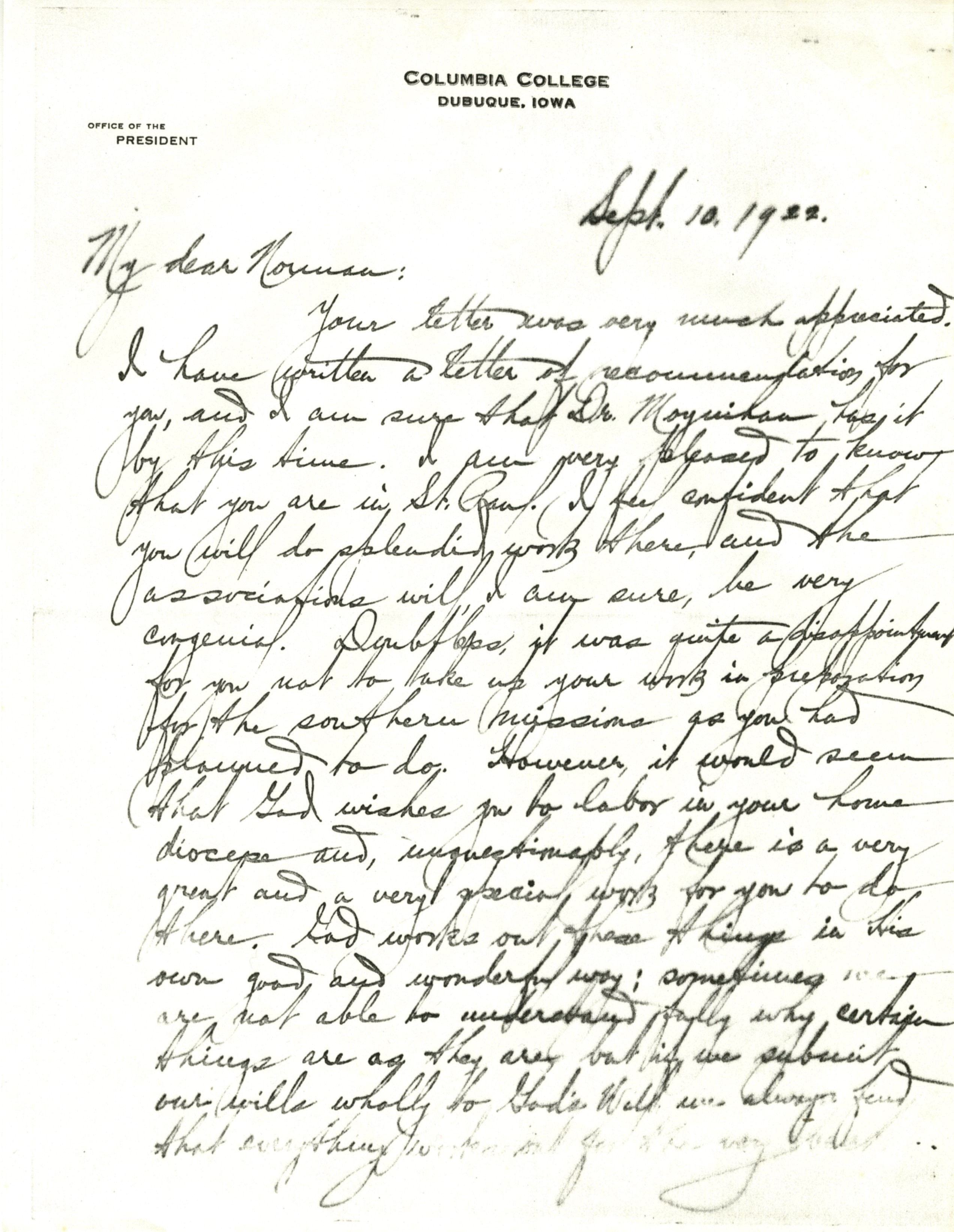
The Christ the King archive contains a personal hand-written letter to DuKette from Columbia College president Rev. Edward D. Howard wishing him well and declaring how much he and the faculty missed DuKette on campus. The pews at his ordination celebration at St. Augustine’s were filled with classmates and faculty from Columbia. Loras College takes great pride in the small but essential role they played in integrating the priesthood. They were and are a small college in an obscure location, a position from which they chose to boldly move the Church towards justice and while the larger seminary preparation schools in the high profile urban centers were stalled by internal dissension, Loras quietly educated Father DuKette and offered him the support he needed to make his way to the priesthood.
Note: after graduation he took a summer course at the University of Michigan and became very ill.
St Pauls Seminary
St Paul’s Seminary opened as St. Thomas Aquinas Seminary in 1885 as a high school, college and seminary. In 1894 St Paul seminary a separate seminary opened up. St Paul Seminary and its precursor have a history of inclusion when it comes to African Americans. St Paul's seminary ordained the first black priests in Minnesota and in the United States. Priests ordained from there include the 2nd ever ordained African American priest in the United States, Father John Henry Dorsey who DuKette knew personally, the first African American Diosecan priest Father Stephen Thoebald, and most notably Father Norman Dukette. Dukette graduated with his “S.T.B.” (Bronzer Reporter)
John Ireland, the archbishop of St Paul Minnesota at the time, held a close relationship with John Slattery, the leader of St Joseph’s society. Through this relationship Slattery and Ireland held the same values about a true American and Catholic Church that included all frequently dining and writing to each other. Through this relationship notable Josephite John Henry Dorsey was admitted as mentioned above. St Paul's Seminary continued to align themselves with the idea of inclusion and thanks to the environment Archbishop Ireland created and DuKette's connections to Josephites and alumni, allowed DuKette to study at the seminary.
Stephen Thoebald
Born in Guyana, Africa in 1874 Thoebald studied journalism in college and later became a lawyer after attending Cambridge University. He was ordained at St Paul's Seminary in 1910. As the first African American Diosecan priest to be ordained in the United States, Father Stephen Thoebald was assigned to St. Peter Claver church in Minnesota, the first and only Catholic African American church of the time. Theobald served as the pastor and leader of St. Peters Claver from his ordination in 1910 to his death in 1932. As it relates to Father Dukette, Theobald was an influential figure to Dukette, and their paths crossed while Dukette was at seminary and Theobald led the St. Peters Claver church, both in St. Paul, Minnesota. It is noted that Theobald also had ties to the Josephite community having some education with the Josephite community.